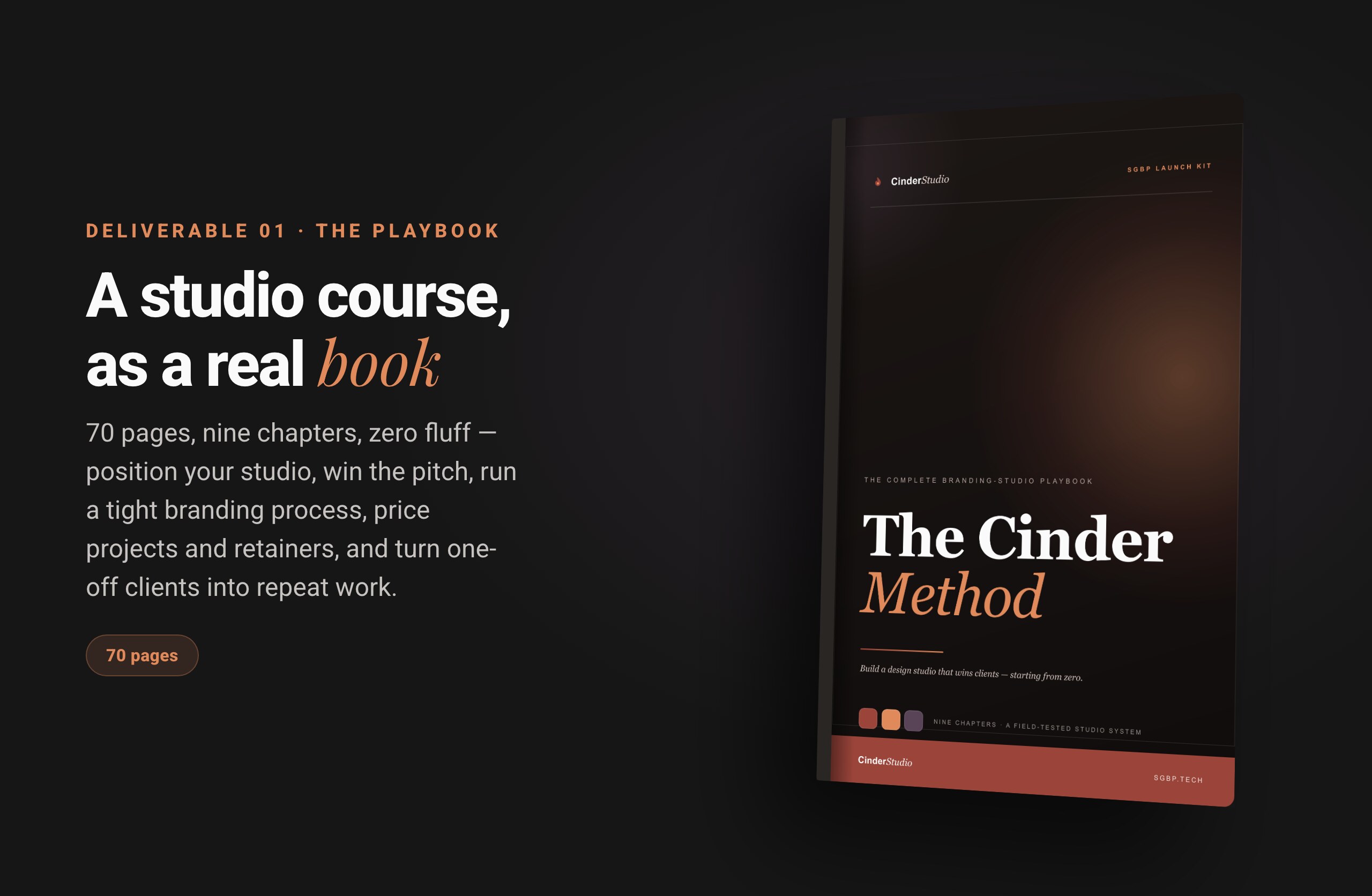
The Cinder Method · 68pp
The Playbook
The complete, honest guide: choose your services, build a case-study portfolio that wins work, package and price engagements, find your first clients, and get paid. Real numbers, no hype.
The Cinder Method is everything you need to start a graphic-design studio that wins clients — the real Cinder Studio portfolio website, a 68-page playbook, your own AI staff, a brand kit and business templates. Turn your design skills into a studio, set up in a weekend.
Secure checkout via Razorpay · instant download · lifetime access, yours to keep
Everything in your kit
The complete, honest guide: choose your services, build a case-study portfolio that wins work, package and price engagements, find your first clients, and get paid. Real numbers, no hype.
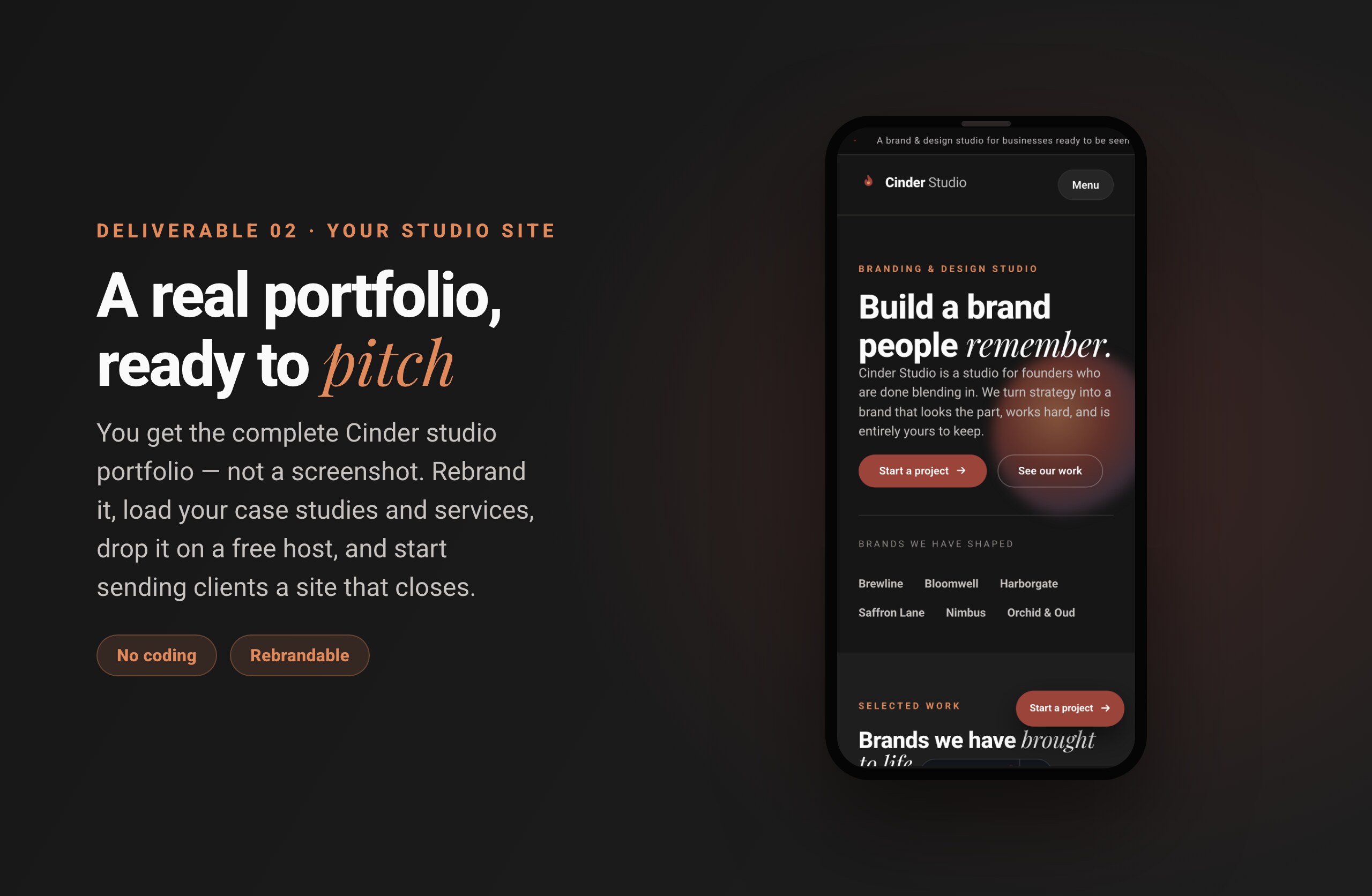
The actual, complete Cinder Studio portfolio as a ready-to-launch template, plus a step-by-step deploy guide. No builder subscription, no code. Put it online, add your work and make it yours.
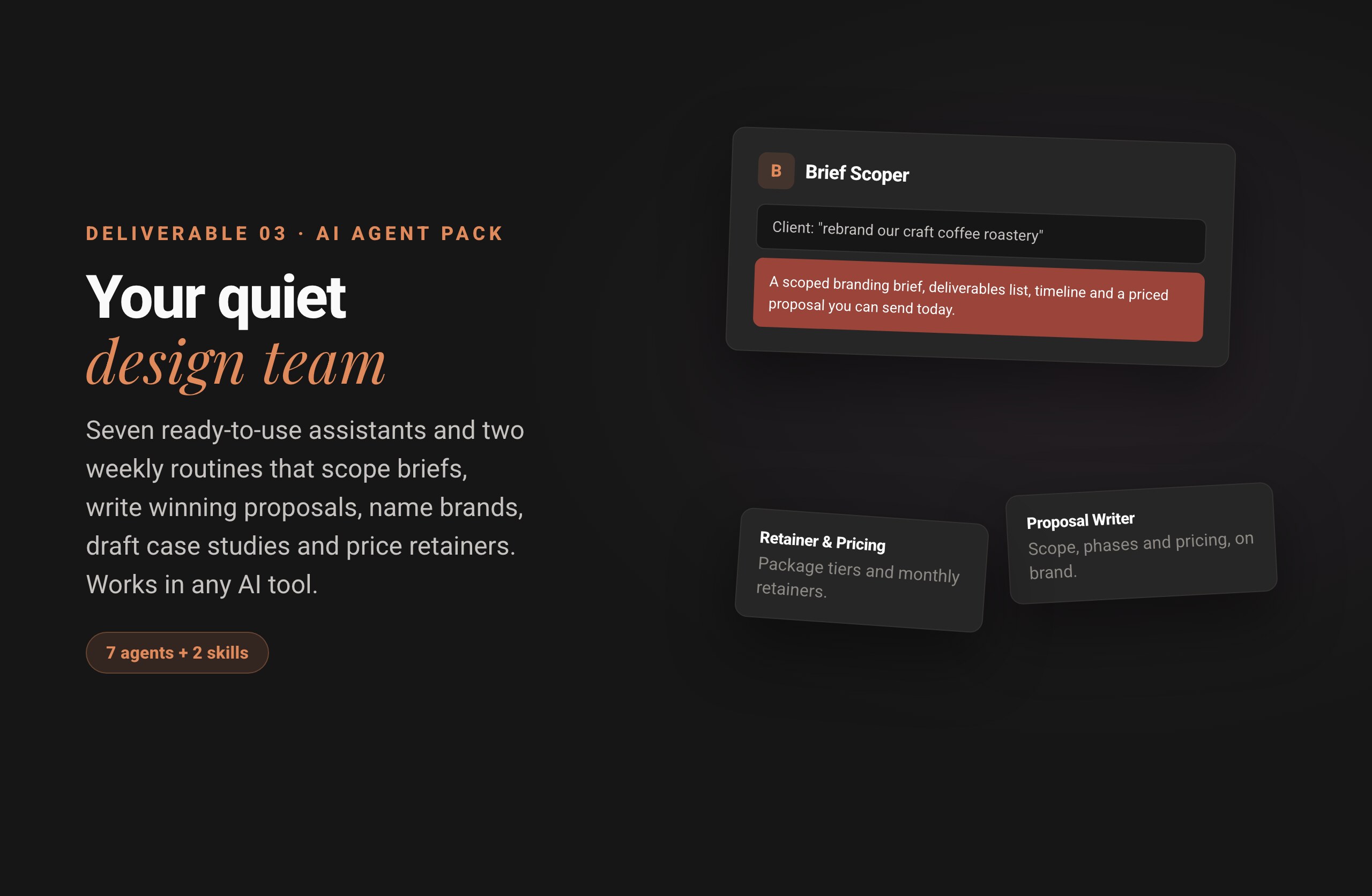
Your quiet studio team: write scoped proposals, turn projects into case studies, and send warm cold-outreach. Works with Claude, ChatGPT or any AI tool. Useful on the first run, no setup.
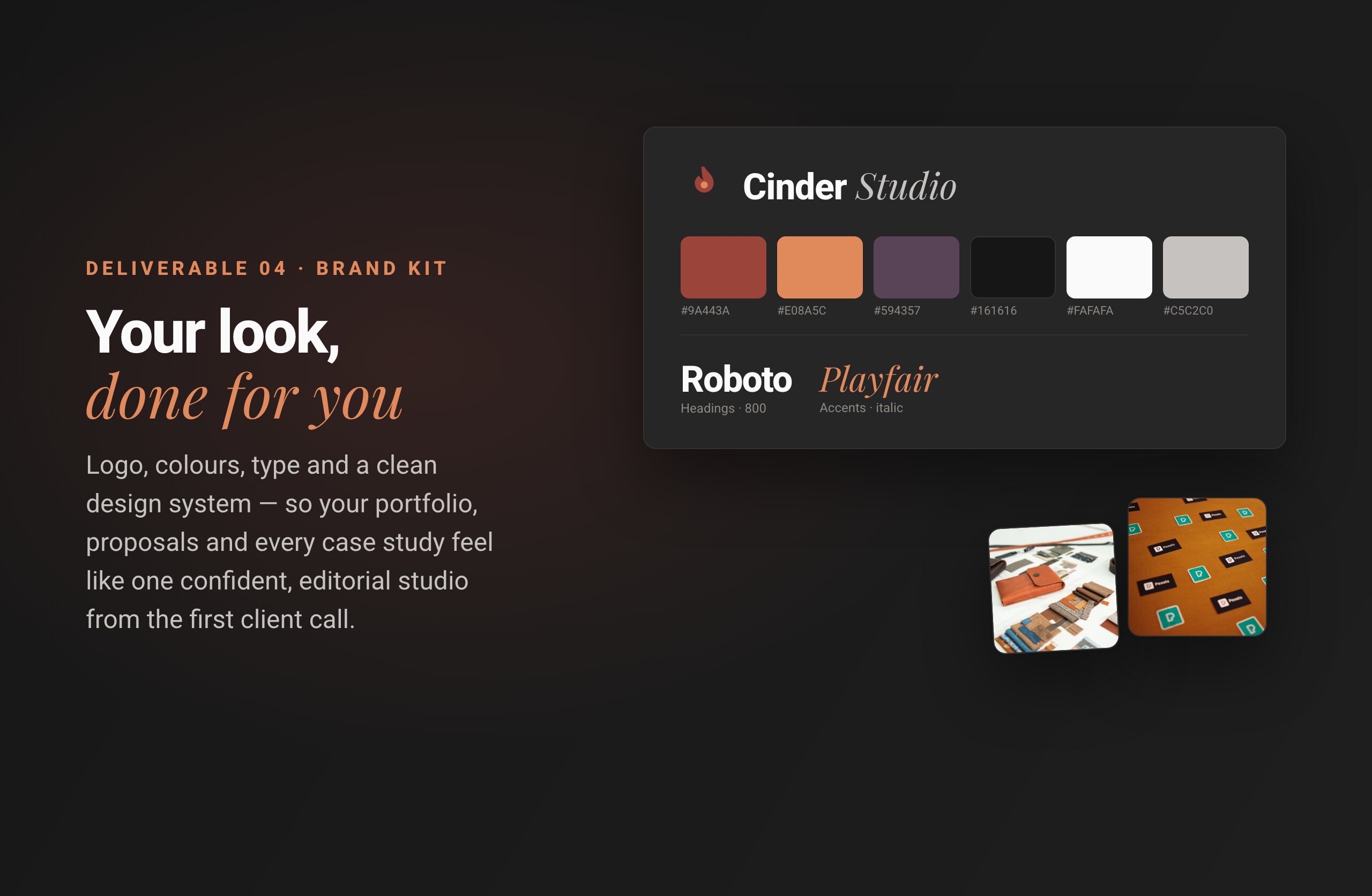
Your logo, colours, fonts and a bold design system. Make your portfolio, proposals and social feel like one confident studio that clients want to hire.
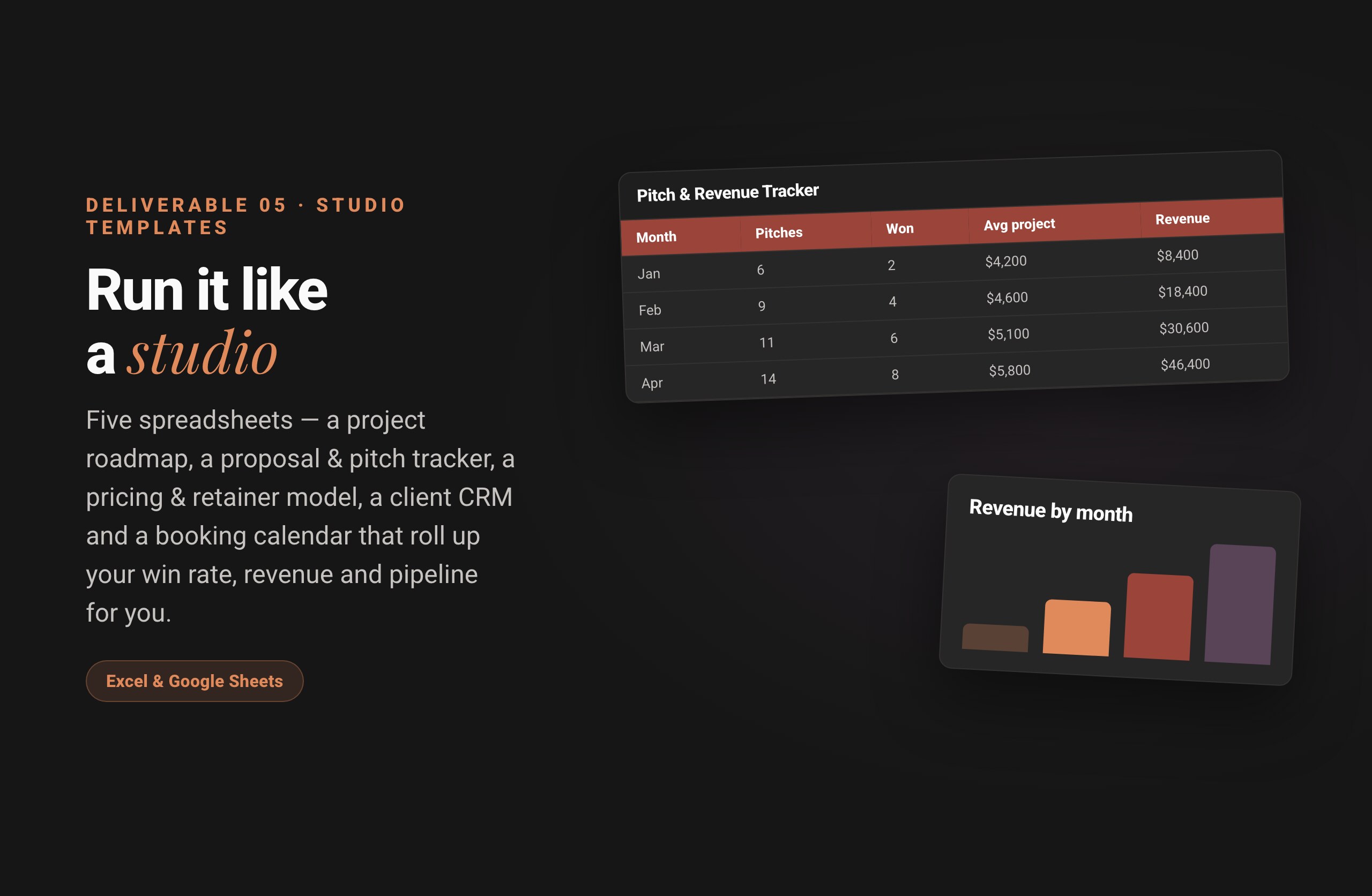
A Business/Portfolio Planner, Financial Model, Income & Expenses Tracker, Client & Lead Pipeline and a Project & Invoice Tracker. They open in Excel or Google Sheets.
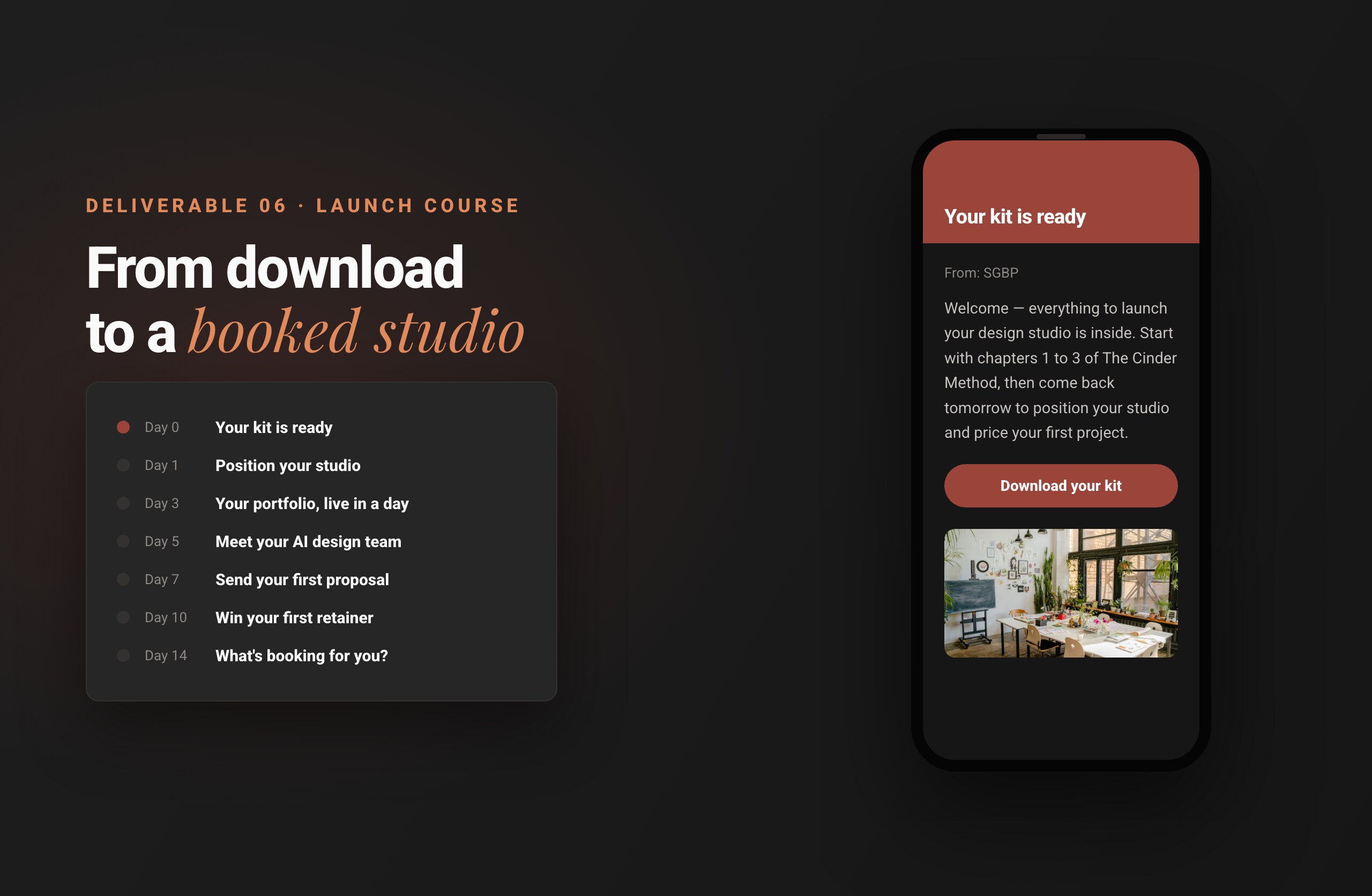
A short daily email sequence that walks you from download to a live studio site winning its first client, one clear step at a time.
SGBP Launch Kit
Secure checkout · instant download
Your kit is ready
We've also emailed your download to your inbox. Grab the files below too — links are valid for 72 hours, and we noted your email for a fresh link any time.
Started by people all over the world
I had the skills and a messy Behance but no clients. The portfolio was live in an afternoon and the proposal agent turned my notes into a scoped pitch a client actually signed.
It looks like a real studio, not a template. The dark case-study layout made my three best projects look like a body of work, and the brand kit gave me a proper identity.
The pricing chapter fixed how I quote. I moved from hourly to value-based project pricing, and my average engagement roughly doubled.
The case-study agent is the part I use every week. I hand it a project and get a challenge-approach-outcome write-up that reads like a real studio wrote it.
My first client came from one cold-outreach message the agent drafted. The portfolio made me look established, and the pipeline tracker kept me chasing the right leads.
I went from side gigs to a real studio income by following the path. Having it all in one place beat piecing it together from scattered YouTube videos.
What sold me was the honesty — no overnight-success promises, just a clear method. The invoice tracker and deposits chapter mean I actually get paid on time now.
I cannot code and dreaded the tech, but it was ten minutes on a free host. The financial model showed me the day rate I needed to hit my number as a studio of one.
Everything in the box
The complete, honest guide: choose your services, build a case-study portfolio that wins work, package and price engagements, find your first clients, and get paid. Real numbers, no hype.
The actual, complete Cinder Studio portfolio as a ready-to-launch template, plus a step-by-step deploy guide. No builder subscription, no code. Put it online, add your work and make it yours.
Your quiet studio team: write scoped proposals, turn projects into case studies, and send warm cold-outreach. Works with Claude, ChatGPT or any AI tool. Useful on the first run, no setup.
Your logo, colours, fonts and a bold design system. Make your portfolio, proposals and social feel like one confident studio that clients want to hire.
A Business/Portfolio Planner, Financial Model, Income & Expenses Tracker, Client & Lead Pipeline and a Project & Invoice Tracker. They open in Excel or Google Sheets.
A short daily email sequence that walks you from download to a live studio site winning its first client, one clear step at a time.
Inside the Playbook
A complete business course in one book, written for someone starting from scratch. Every chapter ends with a clear "do this now" step.
No. The studio site goes live by dragging a folder onto a free host — the guide walks you through every step. If you can send an email, you can do this.
A single download with six parts: the Playbook (The Cinder Method) PDF, the Cinder Studio portfolio template, the AI Agent Pack, the Brand Kit, five business spreadsheets, and the 7-email course. Everything is yours to keep and reuse.
Yes. You receive the complete Cinder Studio portfolio you can preview here, as clean static files you can rebrand and deploy. It is the real thing, not a screenshot.
Yes. The portfolio, brand kit and templates are built to be renamed and recoloured for any design discipline — brand, logo, web/UI, packaging, motion or print.
No, and anyone who promises that is not being honest. Design skill is table stakes; winning and running clients is the business. This gives you the same tools and method a real studio uses to book work. The results are yours.
The 7-email course guides your first two weeks, and if you would rather not set it up yourself, our team can deploy and customise it for you within 3 to 7 working days.
A ready-to-launch website, a 64-page playbook, an AI agent pack, a brand kit and business templates — everything to start.
Click the real, working live demo before you buy — what you preview is exactly the website you get.
Rebrand the site, drop it on a free host, and you are online. No builder subscription, ever.
Everything is yours to rename, recolour and reuse for a business you own — instant lifetime access.
The price meets you where you live — from $19, shown in your local currency, with no surprises at checkout.
Short on time? For $99 the team behind the kit deploys and customises it for you within 3 to 7 working days.
Built by SGBP — 17+ years and hundreds of websites delivered across industries.
Because starting a graphic design studio that wins clients is not one job, it is six — and most designers quit at the first one. The Cinder Method hands you all six done for you: a Playbook to follow, a studio portfolio to show your work, an AI team to pitch and write, a brand kit to look the part, spreadsheets to run the numbers, and a launch email course to pace you. From $19, one download, yours to keep.
Most designers who want to start a studio stall in the same place. They read ten conflicting guides, half-build a portfolio on a free tool, send a couple of nervous applications, run out of steam before the first client, and quietly give up. The problem is never craft — you can already design — it is that there are six separate things to figure out to run it as a business, and no single guide gives you all six. The Cinder Method exists to remove that. It is a business-in-a-box: everything to start a graphic design studio that wins clients, assembled and ready, so you spend your energy on the work and the pitch instead of piecing it together.
The studio portfolio is only one of the six deliverables, not the product. You get the Playbook, a 68-page course that walks you from packaging your design service to your first won client. You get the Cinder Studio portfolio template, a real, clickable studio website you can deploy in about 10 minutes. You get the AI Agent Pack — 7 agents and 2 skills that write proposals and scopes, turn your projects into case studies, draft cold outreach and pitches, and run social posts, client replies, review requests and your newsletter. And you get the Brand Kit, the Business Ops Pack of five spreadsheets, and a 7-email launch course that paces the whole thing.
It is built the way independent design studios actually win work: a bold, case-study-led portfolio that shows outcomes, a clear scope and proposal, and a pipeline you own rather than a profile you rent on a marketplace. The kit teaches that same model — a studio people want to hire, because your work is visible and your proposal lands. There are no income promises here. What there is: a clear path, the tools to walk it, and a price of $19 that is adjusted fairly for your country at checkout, so it is affordable wherever you are.


It is for anyone who can design and wants to start a graphic design studio that wins clients but has been stuck — you keep meaning to start, or you started and stalled, and you would rather have a clear path than more scattered advice. You do not need business experience, a following or a budget beyond $19. It is not for people who want a get-rich-quick scheme or a stream of clients handed to them.
This kit is for the designer who has wanted to go independent for a while and has not, because every guide points somewhere different. Maybe you already do work people admire — logos, brand identity, packaging, print, social, web and campaign design — and you want a real studio portfolio and a way to pitch, not another marketplace listing you do not control. Maybe you tried once, got tangled in building a site, writing a proposal and setting your rate, and left a half-finished portfolio behind. The Cinder Method is built for exactly that person: talented, capable, but tired of guessing what to do next to turn the craft into a business.
You do not need to be technical or a business person. The studio portfolio deploys in about ten minutes with no coding, the AI agents do the parts most designers find hard — the proposal, the scope, the case study, the cold email — and the Playbook assumes you are starting from zero on the business side. You do not need an audience — the kit teaches you how to win a first client honestly, not how to game a big following. And you do not need a budget: it starts at $19, adjusted for your country, which is less than most people spend on a single month of tools they never learn to use.
It is honest about who it is not for. If you want a guaranteed income or a shortcut that skips the work of being good at your craft, this is not that — a studio wins clients because people trust your work and your proposal, and that takes real skill and patience. If you already run a booked-out studio with a waitlist and a team, you are past what this kit covers. But if you can design and are at the start, or stuck near it, and you want everything you need in one place at a fair price, this is built for you.


Because the missing piece is never just one thing. A design course teaches craft but leaves you toolless on the business. A portfolio-builder tool gives you a site but no plan, no proposal, no AI help and no way to find clients. Piecing it together yourself costs weeks and usually ends unfinished. The Cinder Method gives you all six deliverables that fit together, from $19, so you actually reach won clients instead of a folder of half-started parts.
A graphic design course, on its own, sharpens your craft and then leaves you at a blank screen with no studio site, no brand system and no business tools. You finish the videos motivated, open a browser, and hit the same wall you started at — you can design, but you cannot yet win the work. The Cinder Method includes a Playbook that teaches the business — but it also hands you the portfolio, the AI agents, the brand and the spreadsheets, so the moment a lesson lands you have the thing you need to act on it.
A portfolio-builder tool is the opposite trap: you get a site but no idea how to price your work, no proposal or scope to send, no help writing a case study, and no plan for finding clients. You end up with a nice-looking page and an empty inbox. And piecing it together yourself — a free portfolio theme here, a proposal template there, a YouTube tutorial for cold outreach — is how most designers lose a month of evenings and quietly abandon the whole idea. The parts never quite fit, and the momentum dies in the gaps between them.
The kit is designed so nothing falls into those gaps. The Playbook tells you what to do; the Cinder Studio portfolio is where you show it; the AI Agent Pack writes the proposal, the scope and the case study so you are never staring at a blank page; the Brand Kit makes you look established from client one; the Business Ops Pack keeps the numbers honest; and the 7-email launch course paces you from download to your first enquiry. Six pieces, built to work together, from $19 — priced for your country so it is fair wherever you are.
| What matters | The Cinder Method | A design course | A portfolio tool | Do it yourself |
|---|---|---|---|---|
| A clear business plan | Yes — the Playbook | Rarely | No | You improvise |
| A ready studio site | Yes — deploy in ~10 min | No | Yes | You build it |
| AI help to pitch & scope | Yes — 7 agents + 2 skills | Rarely | No | You source it |
| Brand & design system | Yes — Brand Kit | Partly | Partly | You design it |
| Business templates | Yes — 5 spreadsheets | Rarely | No | You make them |
| Paced launch course | Yes — 7 emails | Sometimes | No | None |
| Typical price | From $19 | Tens–hundreds | Tens–hundreds | Your time |

Yes. The Cinder Studio portfolio template is a real, fast, mobile-first graphic-design studio website — the exact one in the live demo — and it deploys in about 10 minutes with no coding. You add your projects in a simple editor, it looks established from day one, and it is yours to rebrand and keep. The Playbook and the 7-email course walk you through getting it live, click by click.
The studio portfolio in the kit is not a mockup or a screenshot — it is the working Cinder Studio site you can click through in the live demo right now. It comes with a bold, image-first homepage, a filterable work index, per-project case-study pages with a challenge / solution / result spine, a full-screen lightbox, an about / solutions page and a working project-enquiry form. You do not design any of it. You add your name and your projects, and it looks like an established design studio from the first day.
Launching it takes about ten minutes and no code. The Playbook and the 7-email launch course walk you through it step by step — creating your free account, connecting a domain if you want one, and publishing your first project as a case study. The AI Agent Pack can even help you turn a past job into a polished case study and write the copy, so you are not staring at a blank page. Everything runs fast and mobile-first, which is how most clients will first open your link — and image performance matters more for a design studio than almost anyone.
It is yours to change and keep. Rebrand it with the included Brand Kit, edit any page, add projects and solutions as you grow, and switch on the enquiry routing when you are ready to take briefs. There are no monthly platform fees baked into the kit, nothing is locked, and the template is designed to scale from your first few projects to a deep body of work without a rebuild.


The AI Agent Pack is 7 agents and 2 skills that do the parts of running a design studio most people find hard: writing proposals and project scopes, turning your work into case studies, drafting cold outreach and pitches, writing social posts, handling client replies, prompting reviews and testimonials, and drafting newsletter emails. You bring the design skill and your judgement; the agents remove the blank page. They work alongside the Playbook so you always know which agent to reach for.
The single reason most talented designers stall on going independent is the blank page — the proposal they never send, the scope they cannot pin down, the case study they never write, the cold email they keep meaning to draft. The AI Agent Pack is built to stop that. It is a team of seven agents plus two skills, each with a specific job, so instead of facing an empty screen you start from a solid draft and shape it into your own. You supply the craft and your point of view — the agents supply the momentum.
The agents cover the real jobs of running a design studio. There is a Proposal & Scope Writer to turn a brief into a proposal and a clear scope that wins the job and protects you from scope creep; a Case-Study Writer to turn a past project into a challenge / solution / result case study that shows outcomes; a Cold-Outreach & Pitch Writer to draft the emails, messages and pitches that open a conversation; and agents to draft social posts, handle client replies, prompt happy clients for reviews and testimonials, and write the newsletter emails that keep past clients coming back. The two skills tie into the portfolio and the Business Ops Pack so your project data and pipeline flow are handled, not fiddled with.
They are not a magic button and the kit never pretends they are — a studio wins clients because people trust your work and your proposal, and that means your craft and your judgement on every job. What the agents do is remove the friction that stops designers ever starting the business: the blank proposal, the scope you avoid, the case study you keep putting off, the outreach you never send. The Playbook tells you which agent to reach for at each step, so the AI team and the plan work as one.
The Playbook is the spine of the kit: a 68-page PDF course that takes you from a blank idea to a graphic design studio that wins clients. It covers why a studio works, choosing and packaging your design service, pricing and scoping, building the portfolio, running your AI staff, finding your first clients across Behance, Dribbble, Instagram, Upwork and Contra, an 11-country appendix for getting paid, and managing projects and money. Every chapter points to the AI agent, spreadsheet or template that does the work.
The Playbook is written to be read start to finish and then kept as a reference. It assumes you can already design but are beginning from zero on the business, and never leaves you guessing what comes next. Each stage — package your service, price and scope it, build the portfolio, find clients, deliver, get paid — is a chapter with clear steps, and each chapter hands you off to the exact tool in the kit that does the doing, so you are never told to "just get clients" without being shown how.
It teaches an honest model: a bold, case-study-led portfolio that shows outcomes, a proposal and scope that land, and a pipeline you own rather than a profile you rent on a marketplace. That is a deliberate choice — the Playbook argues, and shows, that a studio lasts longer when you own the client relationship and pitch on the value of your work, not just your rate. It is also honest about the hard part: a new studio is feast-or-famine until you build a steady pipeline, so the finding-clients and managing-money chapters are about smoothing that curve, not pretending it does not exist.
The chapters below are what the Playbook walks you through. It reads as a real book, and the printed edition in the kit imagery is that same 68-page course. It is yours to keep and re-read, and it is priced as part of the $19 kit, adjusted fairly for your country at checkout.


The Business Ops Pack is five spreadsheets that run the boring-but-vital numbers of a design studio: a Business & Portfolio Planner, a Financial Model, an Income & Expenses Tracker, a Client & Lead Pipeline, and a Project & Invoice Tracker. The Brand Kit gives you a ready logo, colours, fonts and social images plus a design system PDF. Together they make your studio look and run like a real business from day one.
Most new studio owners keep everything in their head, and that is exactly why most fizzle out. The Business Ops Pack replaces the guesswork with five ready spreadsheets you fill in as you go. A Business & Portfolio Planner so you always know your next projects and priorities. A Financial Model so you can see whether your rate and workload actually add up to a living. An Income & Expenses Tracker so you can see, honestly, whether the studio is paying you back through the feast-or-famine months. A Client & Lead Pipeline so no enquiry goes cold and you always know who to follow up. And a Project & Invoice Tracker so every job, deadline, invoice and payment is in one place.
The Brand Kit solves the other thing that stalls people — which is a strange irony for a designer, since you can make this yourself, but rarely do for your own studio when you are busy. It gives you a logo and wordmark, a colour palette, font choices and a set of social images, plus a short design system PDF that explains how to use them, as a fast starting point you can override with your own. You drop your brand into the included portfolio and it looks established from the first project. And because it is a kit, the brand, the portfolio and the templates are already consistent with each other.
You do not have to use every spreadsheet on day one, and the Playbook is clear about that — start with the Client & Lead Pipeline and the Project & Invoice Tracker, and grow into the rest as your studio earns. Nothing here is busywork; each sheet exists because a real design studio needs that number tracked. It all comes as part of the $19 kit, priced fairly for your country, and it is yours to keep and adapt.
The kit teaches an honest model: a case-study-led portfolio that shows outcomes, proposals and scopes that win the job, cold outreach and pitches that open conversations, and a pipeline you own rather than a profile you rent. Nothing is guaranteed — design skill is table stakes, and winning and running clients is the real business — so a new studio is feast-or-famine until you build a steady pipeline. The kit gives you the honest playbook, the tools and the templates to build toward it.
The kit is honest with you from the start: there are no income promises here, and you should be wary of anyone who makes them. Being good at design is table stakes — it gets you in the door, but it does not win or run the client. Winning the work and running it well is the actual business, and a new studio is genuinely feast-or-famine at the beginning: some months bring more briefs than you can handle, others bring none. The whole game is building a steady pipeline so the famine months get rarer. A studio earns because clients find you, trust your work, and are convinced by your proposal, and that is built one good project and one clear scope at a time. What The Cinder Method gives you is not a guarantee — it is a proven, honest model and every tool you need to work it, so your effort goes into the things that actually compound.
The model is straightforward. First, a bold, case-study-led portfolio that shows outcomes, not just pretty work, so a client can see what you can do for them. Client-source platforms are universal and useful as a starting point — Behance, Dribbble and Instagram build reputation and inbound, while Upwork and Contra put you in front of buyers — but marketplaces take a cut and keep the client relationship, which is why the kit is built around a portfolio and a pipeline you own. Second, proposals, scopes and cold outreach that open conversations directly, plus an owned newsletter that keeps past clients and referrals warm, not an audience you rent from a social platform. Third, repeat work and referrals, which is where a studio stops being feast-or-famine and starts being a real business.
Every part of the kit feeds this. The Playbook teaches the model step by step; the AI agents write the proposals, the scopes, the case studies and the outreach; the portfolio shows your work and captures the enquiry; the Business Ops spreadsheets track your pipeline, your projects and your real numbers; and the newsletter keeps past clients close. It is a patient, honest path — not a fast one — and the kit is designed to make walking it as straightforward as it can honestly be.
All six deliverables of The Cinder Method, in one instant download: (1) the Playbook (a 68-page PDF course), (2) the Cinder Studio portfolio website template, (3) the AI Agent Pack (7 agents + 2 skills), (4) the Brand Kit (PDF + design system), (5) the Business Ops Pack (5 spreadsheets), and (6) the 7-email launch course. Nothing is drip-fed and nothing is rented — you download it and it is yours.
These six pieces are designed to work together. The Playbook tells you what to do; the studio portfolio gives you somewhere to show your work; the AI agents do the heavy lifting; the brand kit makes it look the part; the spreadsheets keep the numbers honest; and the email course paces you from download to booked clients.
Quick answers on what you receive, whether you need business skills, the included studio portfolio, rebranding, refunds, how the AI agents work, the $99 done-for-you option, and how pricing works by country.
You receive all six deliverables in one instant download: (1) the Playbook (a 68-page PDF course), (2) the Cinder Studio portfolio website template, (3) the AI Agent Pack (7 agents + 2 skills), (4) the Brand Kit (PDF + design system), (5) the Business Ops Pack (5 spreadsheets), and (6) the 7-email launch course. Nothing is drip-fed and nothing is rented — it is yours to keep.
No coding, and no business experience assumed. The included studio site deploys in about ten minutes with no coding, the AI agents handle the parts most designers find hard — the proposal, the scope, the case study, the cold email — and the Playbook assumes you can design but are starting from zero on the business. If you can design, write a document and follow a step-by-step guide, you can use the whole kit.
Yes. The portfolio deliverable is the real Cinder Studio site you can click through in the live demo right now — a bold image-first homepage, a filterable work index, challenge/solution/result case studies, a lightbox and a project-enquiry form. You add your name and your projects; you do not design or build any of it.
Absolutely — that is the point, and as a designer you will want to. The included Brand Kit gives you a logo, colours, fonts and social images with a design system PDF as a starting point, and the portfolio is fully rebrandable. Change the name, the look, the sectors and the voice, or drop in your own identity entirely; it is yours to keep and adapt however you like.
No, and we would be honest with you if anyone told you otherwise. Design skill is only table stakes — winning and running clients is the real business, and a new studio is feast-or-famine until you build a steady pipeline. You earn only when clients find you, trust your work, and are convinced by your proposal, and that takes real skill and patience. What the kit gives you is a proven, honest model — a case-study-led portfolio, proposals and scopes that win the job, and a pipeline you own — plus every tool to work it. The path is real; the income is up to your effort and your clients.
The AI Agent Pack is 7 agents and 2 skills, each with a defined job: Proposal & Scope Writer, Case-Study Writer, Cold-Outreach & Pitch Writer, plus social, reply, review and newsletter agents. They start you from a solid draft instead of a blank page; you shape the result into your own voice. The kit includes the agents and the instructions for running them, and the Playbook tells you which to reach for at each step.
If you would rather not set it up yourself, there is an optional done-for-you service at $99: we take your name and your work and set your Cinder Studio site live for you within 3 to 7 working days, so you can start pitching straight away. It is entirely optional — the $19 kit already contains everything you need to do it yourself.
The kit starts at $19, and the price is adjusted fairly for your country using purchasing-power parity, resolved automatically at checkout. That means it stays affordable wherever you are in the world, without you having to do anything — you simply see your local price when you check out.
It is a one-time purchase with no monthly fees. You pay once, you download all six deliverables, and they are yours to keep. There is no platform subscription baked into the kit; if you later choose your own domain or hosting, that is a separate, optional cost you control.
Because the kit is an instant digital download that you keep, we are upfront that refunds are limited by nature — once the files are yours, they cannot be returned. If something is genuinely wrong with your download or a file is missing, contact us and we will make it right. We would rather you buy with clear expectations than feel misled.
The studio site itself deploys in about ten minutes. Getting to a portfolio you are proud to send — with a handful of projects as case studies, your brand and a pitch ready — is more realistically a few focused sessions, and the 7-email launch course paces you through exactly that, from download to your first outreach. Winning steady clients then takes time, honestly, because a pipeline and reputation compound gradually.
You can change everything, and as a designer you probably will. The portfolio, the Brand Kit and the templates are starting points designed to be made your own — your name, wordmark, colours, sectors, voice and projects all replace the defaults. It is a head start, not a cage.
It is for anyone who can design and wants to start a graphic design studio that wins clients and would rather have a clear path than more scattered advice — first-time studio founders, freelance graphic designers, brand and identity designers, packaging and print designers, and creatives who want a portfolio and pipeline they own rather than a rented marketplace profile. If you have a design skill you could sell and want everything to start in one place, it fits.
Any design discipline. The portfolio you start from is case-study-led and bold, but the Playbook, the AI agents, the brand kit and the business templates are written for a design studio in general — logo and identity, branding, packaging, print, editorial, social, web and campaign design. You swap in your own work and services; the method is the same.